
 Humans have emotions. That is just how we are wired—to feel things, to experience pleasure, pain, loss, grief, jubilation, jealousy, ecstasy, disappointment. Doubt. Trust. Trouble comes when we decide we no longer want to feel our feelings, and we undertake just about any distraction or vice to render ourselves numb: work, sex, booze, exercise, food. And in trying to avoid our original feeling, we’ve added more: guilt, just for starters.
But feelings themselves don’t even last very long. Theories vary, but various experts say feelings last between 90 seconds and 20 minutes. We all know that at times, mere seconds can feel like hours if it’s negative, so if we have an unpleasant feeling, we rush to squash it rather than sit with it.
But sublimating our feelings or chasing them away with numbing agents, doesn’t help us learn to live with them. People come to therapy because they need help managing their feelings: sadness, grief, anxiety, fear, anger, contempt, jealousy. I say “it’s just a feeling” to my clients on a regular basis. “You can learn to welcome the feeling,” I add. “Invite it in for tea. Get to know it.” I often follow up with “it’s like training a muscle.” Meaning that if they practice enough, tolerating negative feelings will get easier eventually. And I believe that. I do. But it is so hard to put into practice.
I encountered some intense feelings of my own this week in my personal therapy. I’ve been trying to sit with it. I’ve asked for additional sessions with my therapist. I have been trying to dampen the feeling down with television and other distractions, but nothing is helping. Finally, I decided to try inviting it in. Just sitting with it. Just asking it what it wants, what it’s afraid of, what it needs. What it is trying to protect me from.
These are the questions I pose to my clients. I ask them to externalize, to imagine the feeling or emotion or problem as something separate from themselves. Naming it helps. I ask what color it is, what shape, how big, how heavy, what texture. Then I ask the client to imagine talking to the feeling, taking charge. Telling it it can come in, have a seat, and be quiet. Telling it they understand it is there to protect them. It helps to imagine our anxiety riding shotgun rather than as a part of ourselves.
When I cannot tolerate my emotions, and when my feelings seem overwhelming and impossible, I don’t feel like a very good example. And yet, I am the perfect example. A perfect example of what imperfection looks like: someone just trying to sit with the feeling and getting to know it. It won’t hurt me. I might learn something. It’s just a feeling.
 So, I wrote in yesterday’s blog that I had taken and passed my licensure exam. The state licensing exam is also the exam used for those counselors who want to be recognized as Nationally Certified Counselors. It measures competence in several areas: Research, Theories, Assessment, Ethics, and a few other categories. Overall, I did okay on the exam. I didn’t ace it, but I did far better than the minimum requirements for licensure. Also, I totally rocked the Ethics section.
 I finally jumped through one of the final hoops I need to get full licensure. This morning I took, and passed, the state licensing exam. I could have done this as soon as I finished school at the end of 2017, but I did not. I put it off. So, here I am, ready to be done with supervision, primed to strike out on my own.
 One of the primary strategies I use with clients is Cognitive Behavioral Therapy, or CBT. CBT posits that we too often believe our own thoughts. Think about it! Our minds generate bazillions of thoughts every day. And generally, we chose to believe what we think. And most of the time, what we believe is not even true. We make decisions based on faulty beliefs. And then we’re surprised when trouble ensues.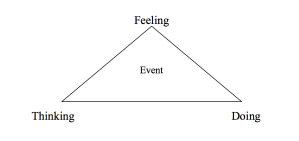
 Therapy with Pam